Fr. Kyle’s Trinity IX Sermon
Updated: Aug 11
+
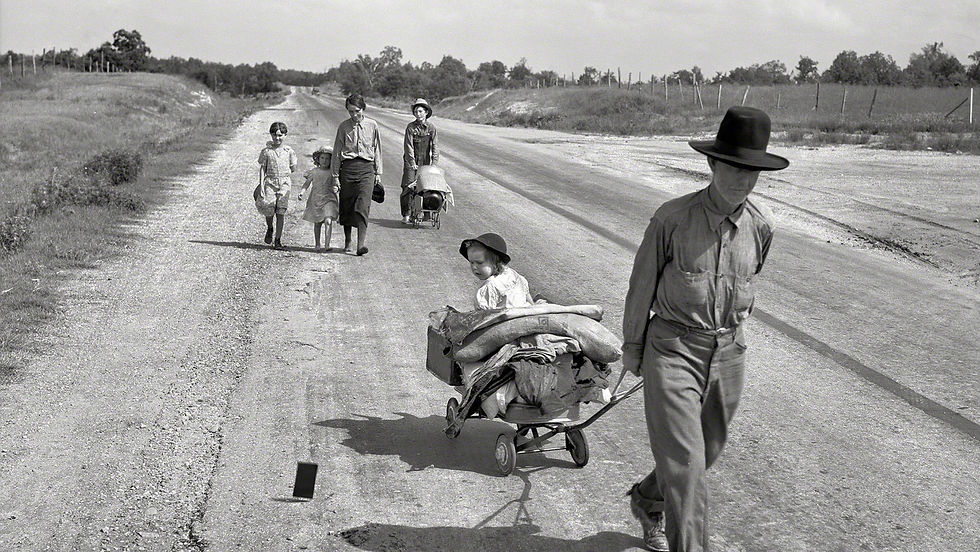
Travel used to be dangerous. It still is, of course, and it can still be arduous, as many of us who have spent time this summer on the interstate or in the air can confirm. Travel and especially moving is no easy task. But going on a journey is not nearly the same experience as it once was. In the age of discovery in the early modern period, it has been estimated that a quarter of all people who travelled by sea perished. That’s a remarkable statistic. And in the ancient world, travel was often perilous for many reasons. There were no state troopers to police the roads. There were no rest stops—not the kind that we expect. And provisions could not always be counted on. If you got into trouble, you were on your own.
The scriptures are laden with many stories of travel. Abraham is called out of Ur of the Chaldees to go into a land that he did not know—into the land of Canaan. Jacob, you remember, gave his older brother at least two very good reasons to want revenge, so Jacob flees back to Abraham’s home country. Joseph is sold into slavery and eventually ends up down in Egypt. Jacob and his sons follow Joseph down to Egypt to seek relief from a famine. Elijah searches the desolate places of the wilderness for a hiding place. Jonah goes off to Ninevah, against his own wishes. Later, the people of Judah are forced into exile in Babylon and then find a way back. The gospels themselves are structured around the travel narratives of Jesus and his disciples. And the Apostle Paul undertakes several missionary journeys across the Mediterranean basin that see him getting in and out of various dangers both from Jewish and Gentile opponents and from the natural world.
These stories of travel are important and we ought to pay attention to them. They form a biblical imagination that is meant to seep into our minds and sink into our bones. If we let them, the scriptures will give us the intuition that goes like this: to belong to the people of God is to belong to a people that has no abiding city here. In Christ, we find our rest—yes—but we must strive to enter into that rest. And this is the work of a lifetime. Every human life is a story of travel on the way toward that rest. We are pilgrims on a journey and, like Christian on his way to the Celestial City, we will encounter many temptations and dangers that threaten to turn us aside from the right path.
The greatest travel narrative in the scriptures and, indeed, in all of human literature is the story of the Exodus and the wandering of God’s people in the deserts of Sinai. We are told at one point that 600,000 men set out on the journey of the Exodus—and many more women and children went along with them (Exodus 12:37). Even taking into account all of the many and various dangers that this mixed multitude might reasonably have encountered, it is stunning that only two of them—two people out of this whole group, Caleb and Joshua—make it to the land that was promised. The rest did not make it to their intended destination.
In the epistle reading for this Ninth Sunday after Trinity, the Apostle Paul wants us to pay attention to this fact. Their story gives us something to consider—a pattern that we must pay attention to—in order to understand the adventure of the Christian life. In the tenth chapter of the first letter to the Corinthians, he compares the Christian life to the experience of the Israelites who went through the Exodus and who traversed the wilderness. And he draws out many unexpected analogies.
The Apostle writes:
Brethren, I would not that ye should be ignorant, how that all our fathers were under the cloud, and all passed through the sea;
Notice that St. Paul refers to the Israelites as our fathers even though he is writing primarily to a Gentile audience. His starting point is this: the mixed multitude called out of Egypt that formed the nation of Israel is the very people that we belong to if we are in Christ. They are our fathers in the faith. Their history is our history; their stories are our stories.
They were formed into the household of God by this experience of going through the Red Sea under the protection of the presence of God—which is the cloud. God was with them in the form of an Angel, as Exodus 14 explains, “The angel of God, which went before the camp of Israel, removed and went behind them, and the pillar of the cloud went from before their face and stood behind them” (19).
The picture we should have in mind is this: they go through the Red Sea on foot, on dry ground, and on either side is the water of the sea that has been pushed away by the wind and up above them is the cloud. They are surrounded by water. Immersed, you might say. And, so, they were baptized together as a group. And this is what the Apostle says:
And they were all baptized unto Moses in the cloud and in the sea;
What does it mean to say that they were all baptized unto Moses? Here’s another analogy of Paul’s. Just as the crossing of the Red Sea is an analog to Holy Baptism, so Moses is a type of Christ. During his time, Moses was a mediator between God’s people and God himself; he spoke on behalf of the people to God and he spoke on behalf of God to the people. He conversed with God, we are told, face to face. He embodied and shared the very glory of the the Lord. All of which is to say, Moses was the head of this people during his generation. So Christ is our head, too, and an even better and complete mediator, for not only does he share the revelation of God with us through words and deeds, but Our Lord is God himself, just as he is human himself.
But the Apostle is driving at something here: his purpose is not to draw comparisons between the Church and the Israelites in order to emphasize a contrast. He’s not trying to make the point that our situation is qualitatively different but rather that we share something profound in common with our fathers in the faith. This becomes clearer in the next sentence. He writes:
And they did all eat the same spiritual meat; and did all drink the same spiritual drink (for they drank of that spiritual Rock that followed them, and that Rock was Christ).
On their journeys sans rest stops, the Israelites were given nourishment and provision in the form of manna, which the psalmist calls the bread of angels (78:25) and which appeared on the ground once each day, as well as water from the rock. St. Paul follows a traditional rabbinic reading of the Torah that the rock followed them. The Wisdom of Solomon tells us that the water from the rock was not a one-off event, but a regular, perhaps daily, process: “When they thirsted they called upon thee, and water was given them out of flinty rock, and slaking of thirst from hard stone” (11:4). The source of these provisions was Christ himself, who was also the very angel who went before them in the Exodus.
Now, these provisions were plainly material—they provided for material needs—so we might reasonably ask the question, What makes them spiritual meat and spiritual drink? Well, the first thing we have to say about that is that just because something is material does not mean it is not spiritual. Many material things are profoundly spiritual—such as you and me. And the two central sacraments of the church are similarly material: they impart spiritual graces but we receive them as water and bread.
And like the Holy Eucharist and Holy Baptism, the water from the rock and the bread of angels was a sign of God’s favor and an effectual sign of God’s blessing—and, crucially, a means by which they were being brought along and protected in their journey to the promised land. The sacraments are the same for us. They nourish us spiritually. They sustain our life in Christ. They give us genuine graces to continue on our journey.
And here is where St. Paul’s reading of the Exodus story takes a turn:
But with many of them God was not well pleased; for they were overthrown in the wilderness.
He reminds us of this startling fact that so many of them set out from Egypt and only two made it to the promised land. They so neglected the gifts of God that God made sure that their generation had passed away almost entirely before the People of God could enter the Promised Land. The fact that God had provided for them and given them signs of his favor was not a guarantee that they would reach their intended destination—they had to cooperate along the way.
St. Paul lists here different ways in which the Israelites followed paths of disobedience. They were driven by evil desires. They engaged in idolatry. They committed sexual sin. In each of these ways, they tempted Christ. Which is to say that they tried his patience. They acted as if they were not confident that he was the Lord.
And so these fathers in the faith have given us something to learn from. We should not follow them, St. Paul says, in their disobedience. And he emphasizes in particular that we should not follow them in their murmuring—in their complaining. How easy it is to complain—to ourselves and to one another. Perhaps you know what I mean: to maintain that inner monologue about the inconveniences and unpleasantnesses of life. That kind of talk never stays just talk. It becomes a way of life and the basis for perhaps a family culture or a larger social culture that does not treat the given things of this life as genuine gifts from a God who cares for us and knows what we need.
Now all these things happened unto them for ensamples: and they are written for our admonition, upon whom the ends of the world are come.
From their experiences, we can learn a few things. One is that the simple duties of obedience and normal faithfulness are not beneath us. They are not beneath anyone of us. They are the path that God has given us. Another is that we are capable failure. It is possible that we might not reach our destination—which is to say we might not find the rest that has been promised to us in Christ, the new Jerusalem. Like the Israelites, we might turn aside. God gives us this dangerous freedom. And this is worth reflecting on not in order to despair but in order to examine ourselves—to take stock of where we are, and to re-align ourselves with Christ. And finally, we ought to avoid being self-confident. Wherefore let him that thinketh he standeth take heed lest he fall. Our confidence rests in Christ, not in our own capacities. He will be faithful to us in every trial and temptation, even to the edge of doom.
And so we look to Christ, who looks after us even in strange places—even when we must go away from family and friends, even when we must meet as a Church in a country club—and he gives himself as heavenly food, the wayfaring bread in all of the journeys of this life.
+


